

Don’t miss our latest updates
Get news and content delivered straight to your inbox
Thank you! Your submission has been received!
Oops! Something went wrong while submitting the form.


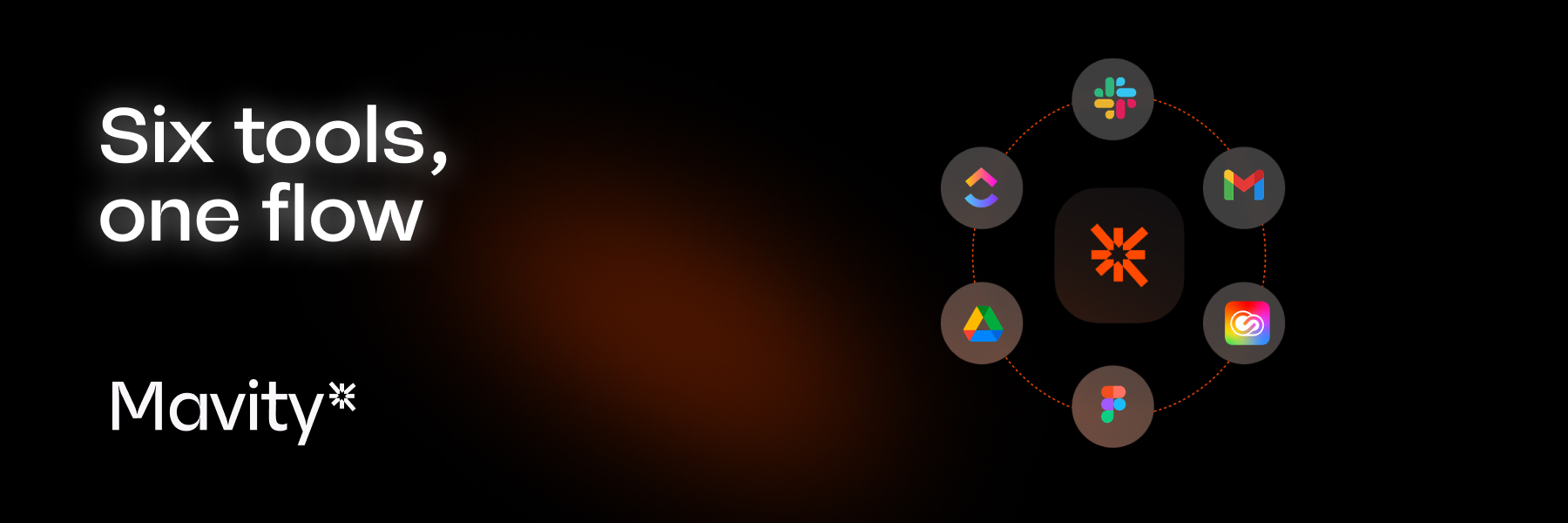
Brief lives in a Google Doc. Feedback happens in Slack, except when it happens in email, except when someone leaves a comment directly on the file and nobody sees it for two days. Approvals get a "looks good" in a thread that immediately gets buried. Final assets get dropped in a Drive folder with a naming convention only the person who made it understands. Status gets tracked in a spreadsheet that's accurate exactly once a week, right after someone manually updates it.
If that sounds familiar, it's not because your team lacks talent. It's because the work is scattered across six tools that were never built to talk to each other.
I've sat in enough client escalations to know the pattern by now. It's rarely "the creative was bad." It's "we approved version 2 but production built version 1," or "the client fed back three weeks ago and it's sitting in an inbox nobody checks," or "nobody knows if this is actually done." None of that is a skills gap. It's a visibility gap, created by having the brief in one place, the conversation in another, and the actual files somewhere else entirely.
Every handoff between tools is a place where something gets lost, delayed, or misread. Multiply that by every client, every pod, every week, and you get an operation that feels busy but isn't actually moving as fast as the hours put into it would suggest.
This isn't about consolidating for the sake of a tidier stack. An ai creative operations platform, done right, is specific: brief, production, feedback, approval, delivery, and reporting living in the same flow, so nothing has to be manually carried from one system into the next.
A brief comes in and the pod can see it immediately, no forwarding, no "did you see the email." Feedback happens on the actual asset, not in a parallel thread that may or may not get read. An approval is a clear status, not a "looks good" that someone has to go find later. And when a client asks where something stands, the answer is already visible, not something we have to go reconstruct from four different apps.
That's what AI content workflow automation is supposed to buy you - not fewer steps for the sake of fewer steps, but no step depending on someone remembering to do it manually.
Less chasing. That's the honest, unglamorous answer. Fewer messages that start with "hey, quick question" because the information nobody could find is now just sitting where it should be. Fewer versions built off outdated feedback because the feedback was never lost in the first place.
And for clients, it means they're not waiting on us to go figure out our own status. The information is already there.
None of this required more talented people. It required the work to stop living in six places that don't talk to each other, which is exactly what building Mavity as one all-in-one AI content creation platform was meant to fix.
If your team is still stitching status together from six different tools every week, that's a workflow problem, not a headcount problem.
Sign up for Mavity, and bring your own brief in, see what brief-to-delivery looks like collapsed into one place.