Don’t miss our latest updates
Get news and content delivered straight to your inbox
Thank you! Your submission has been received!
Oops! Something went wrong while submitting the form.


Since we started integrating AI into our creative processes, there’s one concern I hear constantly: “How do I make sure everything I generate still feels like my brand?”
And I think we often look for the answer in the wrong place.
We try another model. Rewrite the prompt. Add more references. Generate again.
But there’s a much more important question we should ask first: how clear is your brand, really?
Because if you and your team are still figuring out what it means to look or sound on-brand, an AI tool is unlikely to solve that for you.
One of the most common mistakes is delegating not only execution to AI, but also the definition of the brand itself.
AI can help you explore a visual direction, generate images, write copy, or create variations. But it’s an assistant. It doesn’t have a 360° view of your business, what you want to represent, or where your communication should evolve next.
That direction is still yours to define.
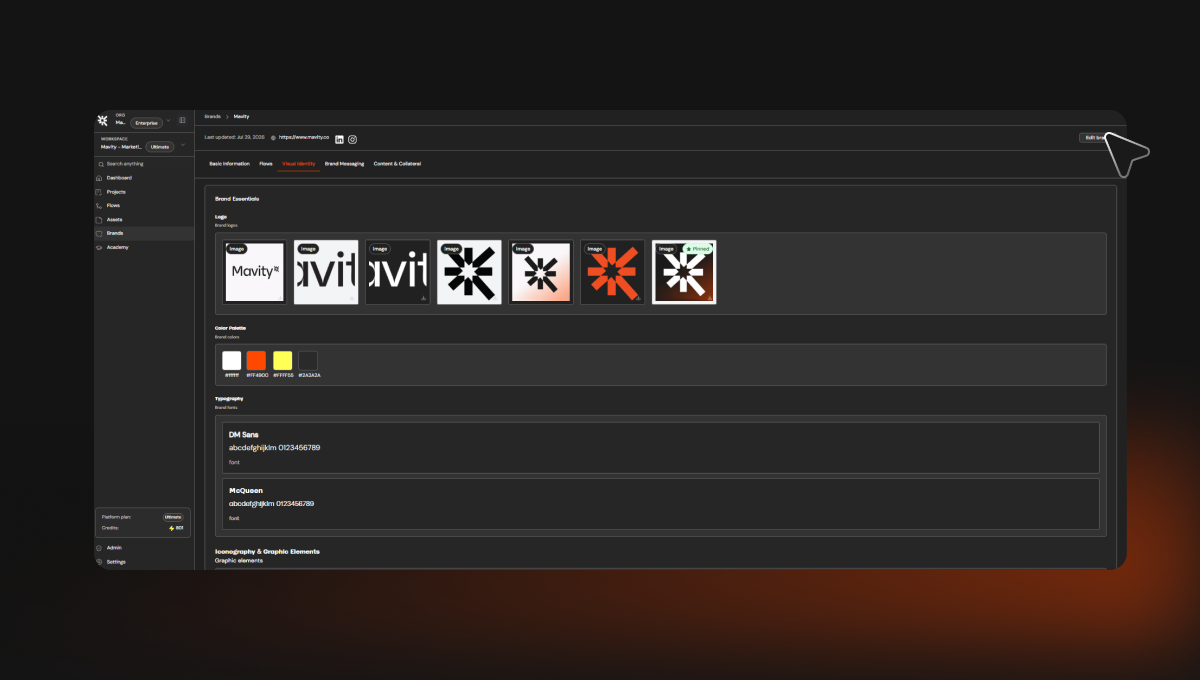
So before thinking about consistency with AI, you need a clearly defined and documented brand: personality, tone of voice, messaging, colors, typography, photography style, illustration, references, and, very importantly, what doesn’t belong to the brand.
Your team needs to be aligned, too.
If we change direction every week because something “feels off” or “we don’t like it anymore,” the problem isn’t that AI is being inconsistent. We are.
Once that foundation exists, tools like Mavity Brands can help centralize your brand context and bring it into your Projects and Flows, so AI doesn’t have to start from scratch every time.
Having a well-defined brand doesn’t mean creating one gigantic prompt that tries to explain everything.
My recommendation is to work in chapters.
A photography series needs rules around lighting, composition, casting, locations, and color treatment. An illustration series for the exact same brand might need rules around line weight, shapes, textures, proportions, and color usage.
The brand is the same. The instructions for building each expression of that brand are not.
That’s why you can have one base prompt for photography, another for illustration, another for product imagery, or even different Flows depending on the type of content you’re producing.
For example:
Photography: warm natural light, editorial composition, real people, spontaneous moments, visible imperfections.
Illustration: organic shapes, irregular lines, limited color palette, visible texture, simplified proportions.
Both can feel perfectly on-brand without looking the same.
There’s something we do all the time with GenAI: we get an amazing result, and then the following week we start a brand-new conversation from scratch.
We shouldn’t.
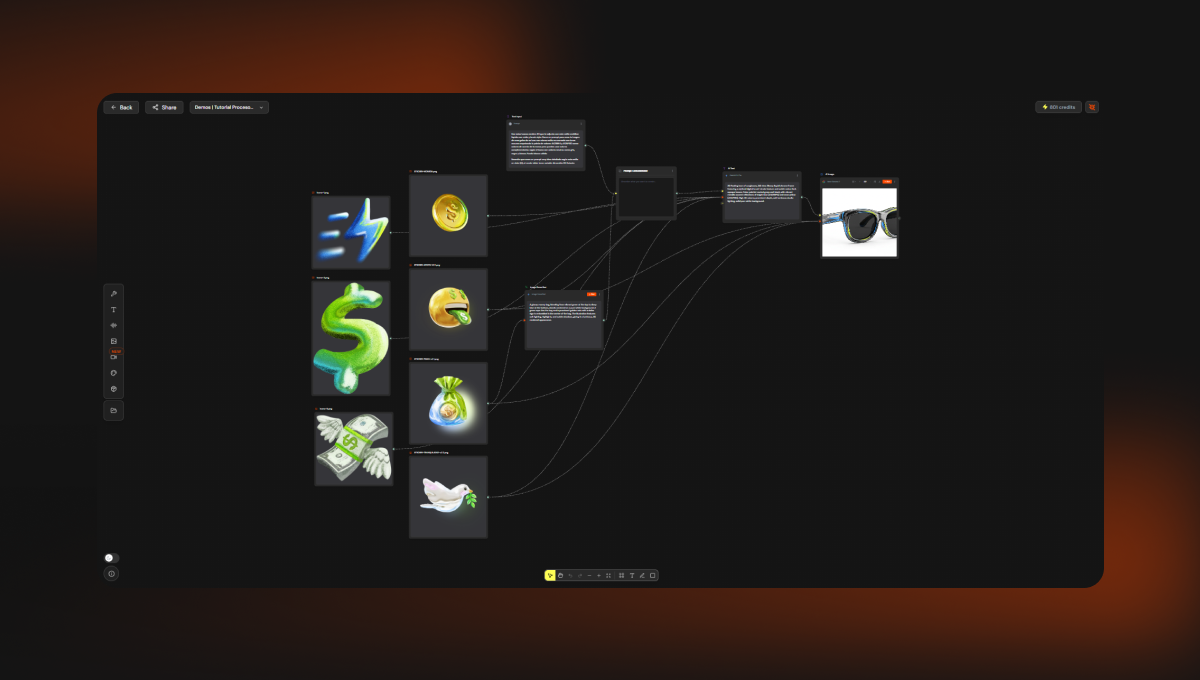
When you find a combination of prompt, references, and model that truly understands your brand, save it. Document what worked. Turn it into a Flow. Reuse it.
That’s one of the most interesting shifts that comes with working with AI: a good creative process can become an asset, too.
In Mavity, Flows allow you to save, edit, and rerun those processes instead of relying on isolated prompts every time you need to create content.
Choosing the right model also matters. Not every model interprets photography, illustration, text-based compositions, or products in the same way. Part of the process is testing which model works best for each expression of your brand and keeping that decision within your system.
I think this is the most important idea.
AI can help us produce faster, generate variations, and scale our creative work significantly.
But the direction is still ours.
If the brand isn’t clear, the outputs won’t be either. If the rules are constantly changing, AI will change along with us.
Brand consistency with AI doesn’t start with a better prompt. It starts with a better-defined brand.
And once that clarity exists, AI stops being a tool that simply generates beautiful things and starts becoming a tool capable of executing a creative direction again and again.
With Mavity Brands, you can centralize your brand identity and use that context across your Projects and Flows to create with AI without starting from scratch every time.
You define the direction. Mavity helps you keep it.