

Don’t miss our latest updates
Get news and content delivered straight to your inbox
Thank you! Your submission has been received!
Oops! Something went wrong while submitting the form.


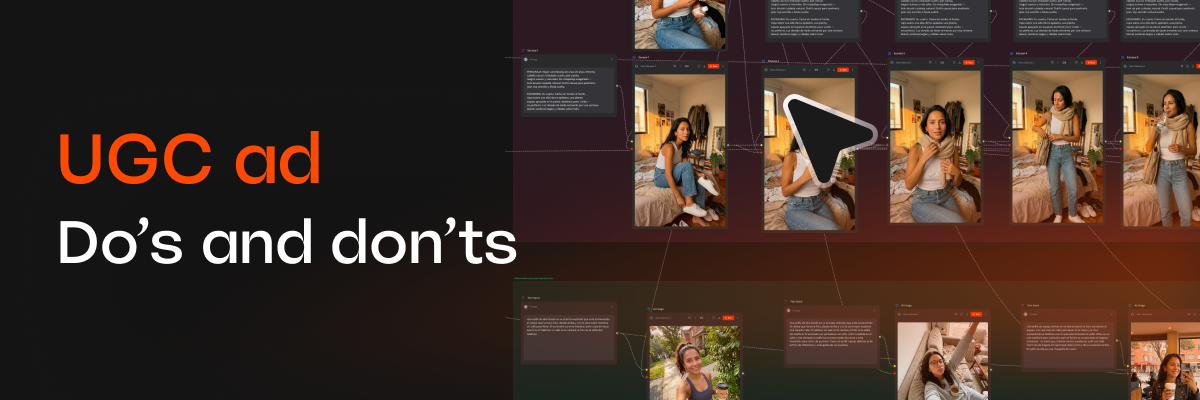
UGC ads (the ones that look like a real person casually recommending a product) have quietly become the workhorse of paid social. They feel native to the feed, they earn trust that studio-polished ads don't, and platforms reward them with cheaper reach.
The problem was always production: finding creators, briefing them, waiting for footage, hoping the usable take mentions your product correctly. AI changed that math completely.
So instead of explaining this in the abstract, I'm going to walk you through a real flow we built in Mavity: a full UGC campaign for Olaya, a demo sparkling water brand: from designing the bottle to a creator talking to camera about it, in her own bedroom, in her own words. Step by step.
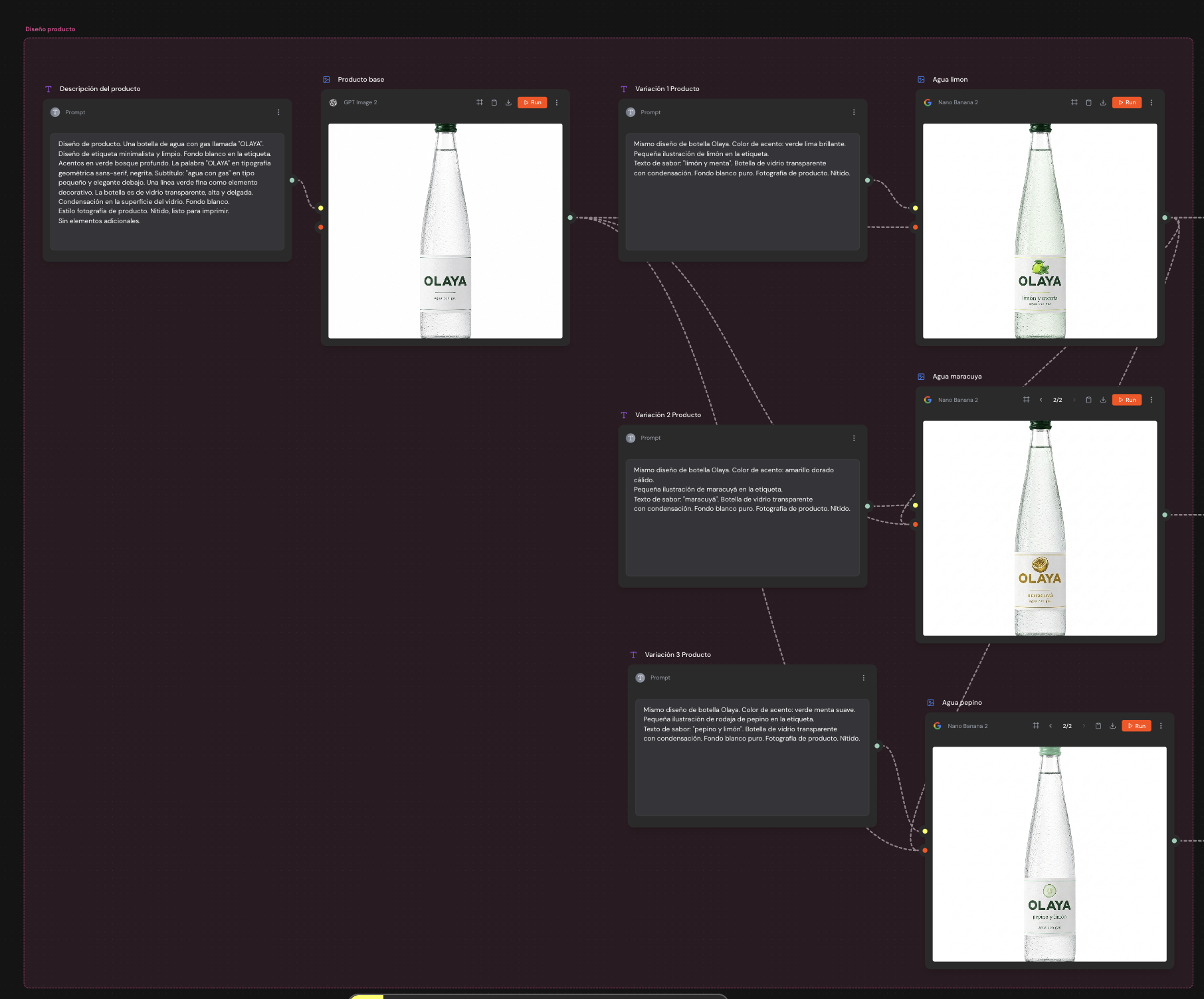
For our demo we designed the product itself with AI: a clean, minimal sparkling water bottle with a white label and one accent color. But here's the part worth stealing regardless of whether your product is real or generated: we created it as a set.
One base prompt defines the bottle. Then three short variation prompts change only what needs to change: lime green accent with a lemon illustration for lemon-mint, warm golden yellow for passion fruit, soft mint green for cucumber-lime. Same bottle, same layout, same lighting, three flavors.
That "same design, change only X" pattern is how you get a product line that looks like it came from one brand instead of three different AI sessions. If you're working with a real product, skip the design step and use your actual product photos as the reference, that's what makes the final ad commercially usable.
This is the single most important technique in the whole flow. Before generating any scene, we wrote a short reusable block describing two things:
The character: a Colombian woman around 26, dark wavy hair worn loose, natural features, no exaggerated makeup: a real skin, real person look. Simple outfit: jeans and a plain top.
The setting: her bedroom. Unmade bed, clothes on a chair, stacked books, a plant, a mirror leaning against the wall. Aesthetic but lived-in, not perfect. Golden afternoon light through a side window.
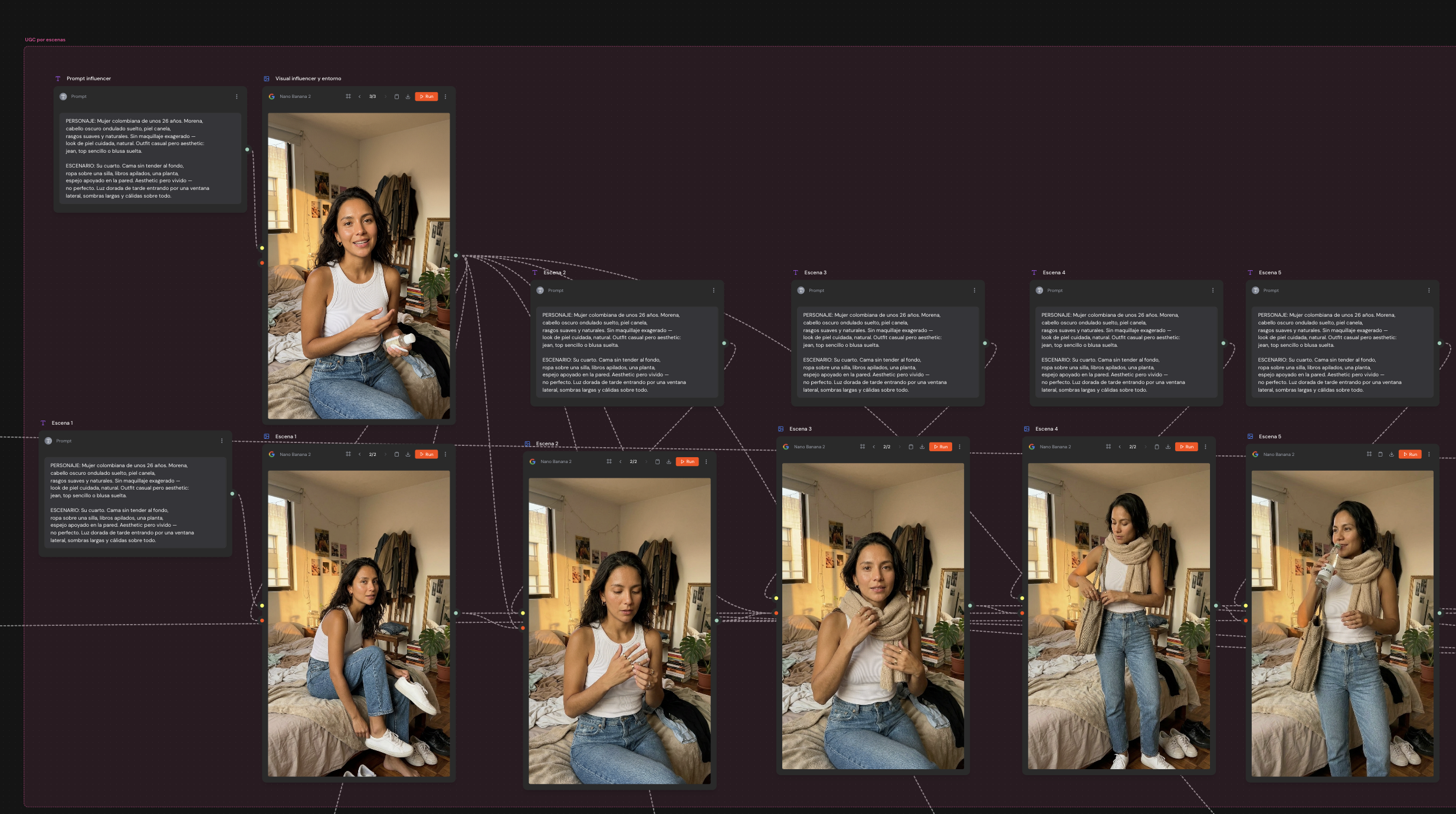
Then, and this is the trick, that exact block gets pasted at the top of every scene prompt in the flow. Not paraphrased. Pasted. The model reads the same character and the same room every time, which is why she's recognizably the same person in scene one and scene five.
Notice what the setting description is doing, too: "unmade bed" and "not perfect" are doing more work for the UGC format than any camera instruction could. The imperfection is the aesthetic.
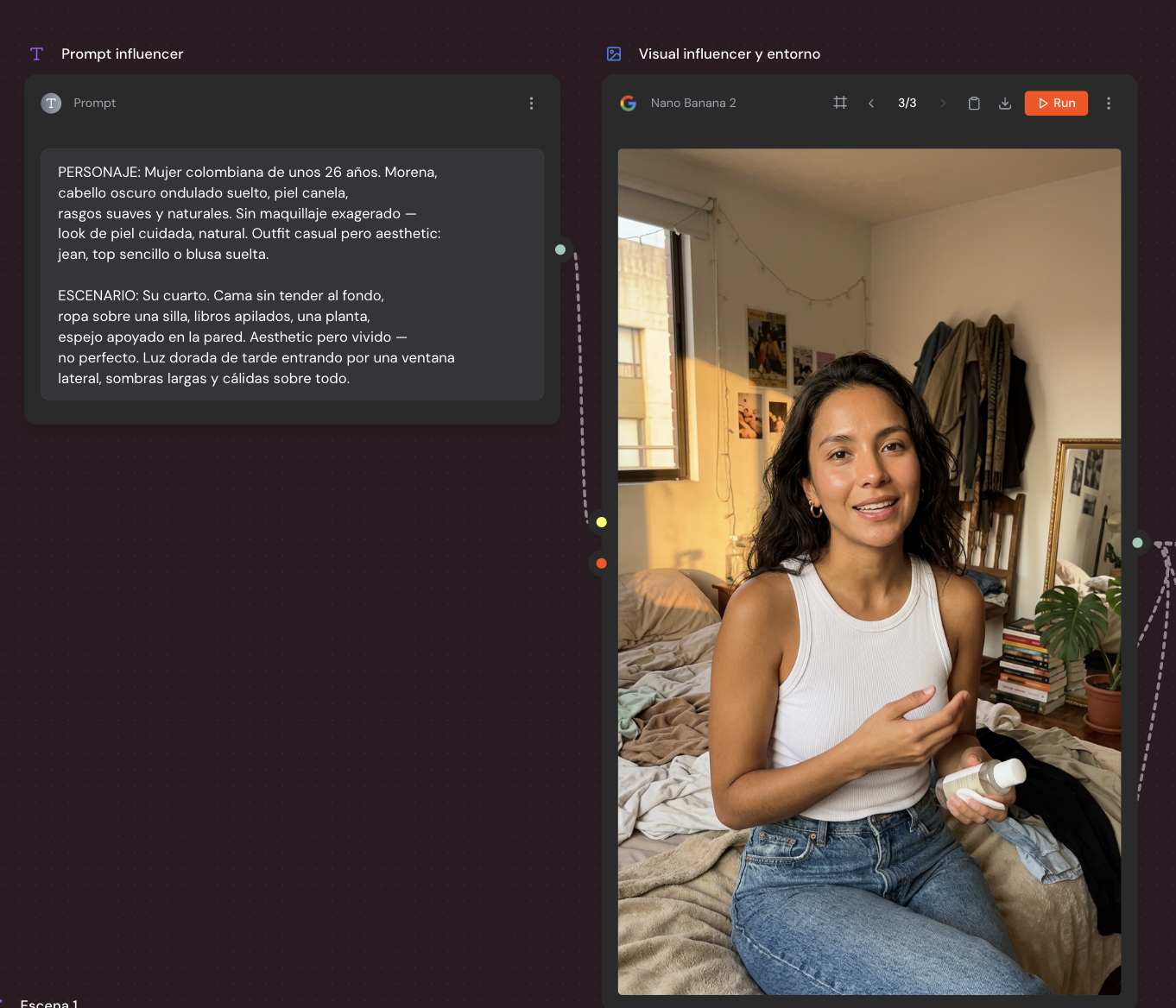
With the character block locked, we generated five vertical scenes: sitting on the edge of the bed, a hand on her chest mid-story, trying on a scarf, holding the bottle, taking a sip. Each prompt is just the shared block plus one line about what she's doing.
Five images, one person, one room, one afternoon. It looks like someone propped up a phone and talked, which is exactly the point.
Here's the actual structure of our script, five short beats, one per scene (ours was in Spanish this format travels across languages beautifully):
The hook: "Okay, I have to tell you something." Two seconds, straight into it.
The context: "I was the person drinking coffee all day, and by the afternoon I never knew what to drink." A real, small, relatable problem, not a crisis.
The discovery: "Until I found Olaya." That's it. One line.
The product truth: "It's sparkling water but flavored, no sugar, nothing weird." Notice this is the only line that describes the product, and it sounds like a person, not a label.
The soft close: "I don't know, it kind of reminds me I can pause for a moment... try it and tell me." No urgency, no discount code screaming. An invitation.
If any line in your script would fit on your website, rewrite it. Reading it out loud is still the best quality check there is.
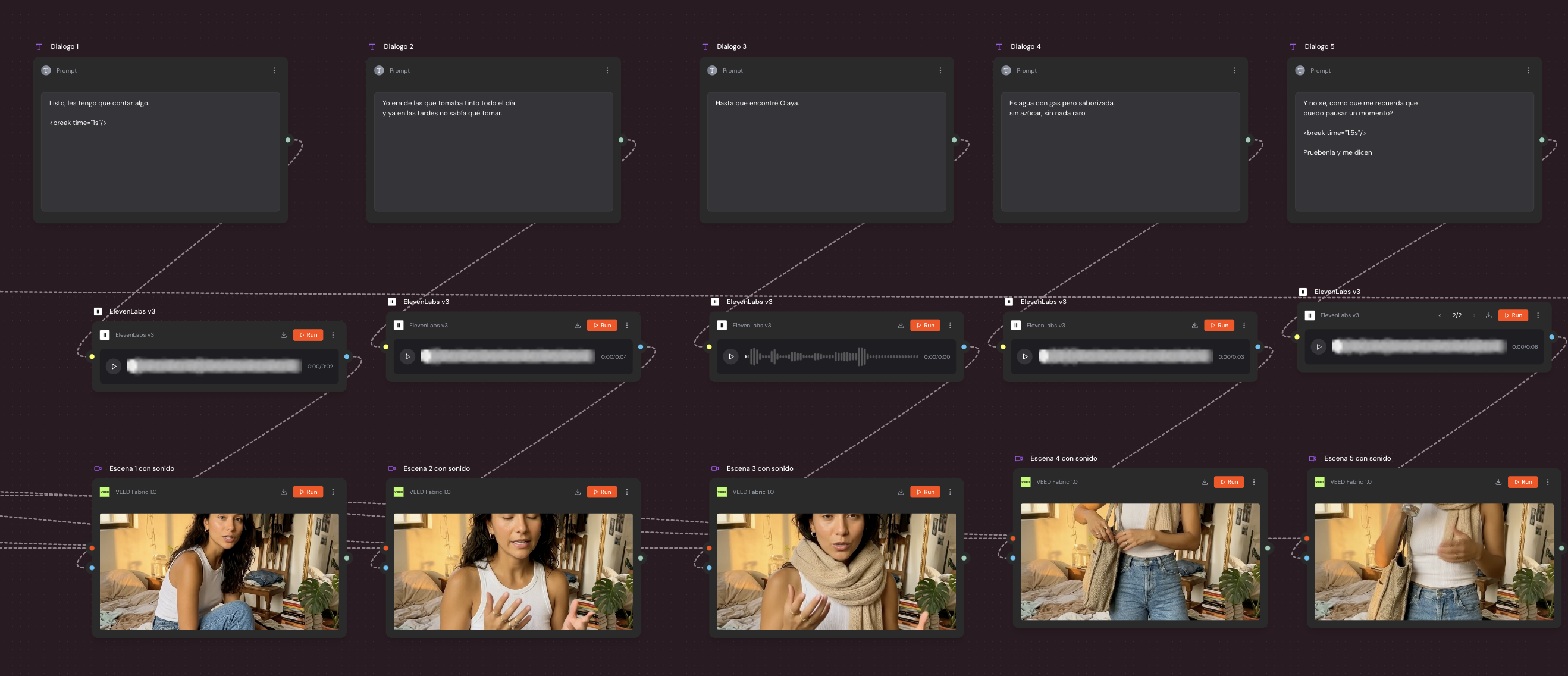
Each script beat goes through two steps. First, voice generation: the text becomes natural spoken audio, with pauses written directly into the script (a one-second break after the hook does a lot of dramatic work). Then a lip-sync step combines each scene image with its audio, and the still images become talking video.
This is the moment the whole thing clicks: five casual scenes plus five audio clips become five clips of a person telling you about a drink in her bedroom. Cut together, that's the ad.
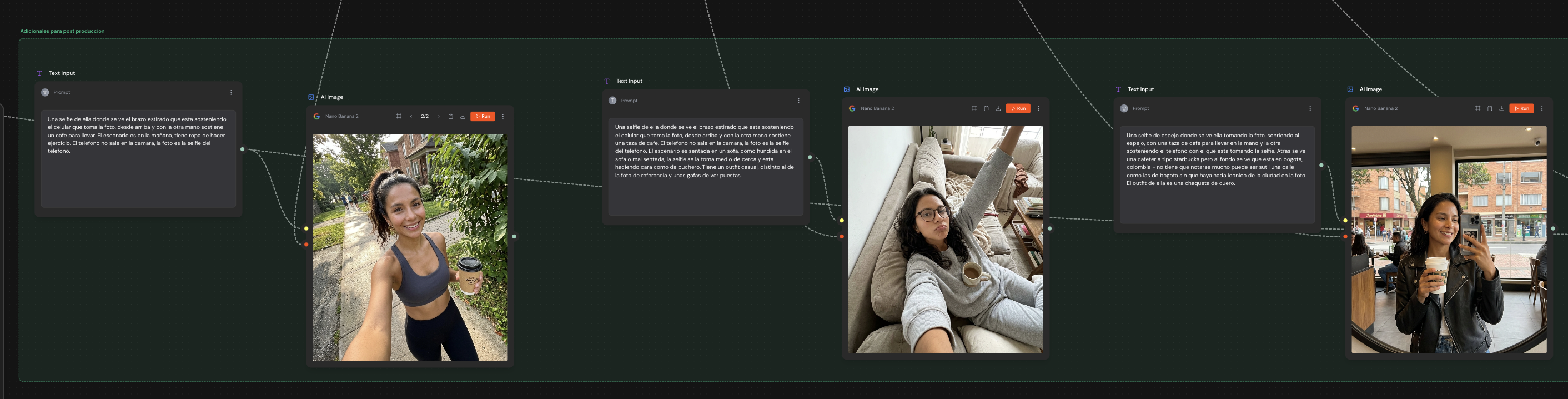
This was my favorite detail in the flow. After the ad itself, there's a post-production section generating extra lifestyle content of the same creator: a post-run selfie with a coffee, a lazy couch shot, a mirror selfie at a café in Bogotá, a park photo with the Olaya bottle.
Why? Because a UGC campaign rarely lives as one video. You'll want statics for carousels, alternate hooks, retargeting variations. Generating the creator's "world" in the same flow: same face, same wardrobe logic, same city means every future asset stays consistent, without starting over.
I want to be direct about this, because this flow features a synthetic creator, and that comes with real obligations. Disclose AI-generated content according to each platform's rules (most now require it for realistic synthetic people). Keep the product claims true: "no sugar, nothing weird" only works as a line if it's accurate. And if your product is real, use your real product imagery.
The UGC format works because it feels trustworthy. The fastest way to burn that trust, for your brand and for the format is to use it to say things that aren't true. Don't.
Look at what this one flow contains: a product line designed as a set, a consistent creator with a written identity, a script with an honest arc, voice, lip-synced video, and a library of supporting content. The most casual-looking format on the internet, built on the most systematic production behind it.
That system used to require an agency, a creator roster and three weeks. Now it's one canvas. The casual look is the craft.