Don’t miss our latest updates
Get news and content delivered straight to your inbox
Thank you! Your submission has been received!
Oops! Something went wrong while submitting the form.


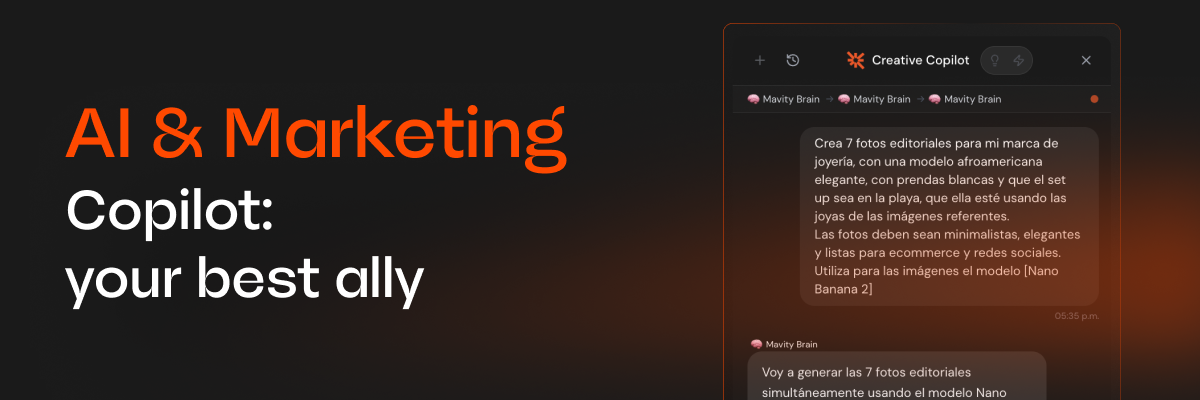
There's something I learned while designing Mavity's Copilot that changed how I think about AI tools: people don't writegood prompts. And that's fine.
We write half-finished sentences. We ask for the result before giving the context. We mention the brand at the end, if a tall. We assume the AI already knows things that only exist in our heads. That's how humans communicate: and a good AI marketing copilot has to work with that, not against it.
In this article I want to explain what a copilot actually does between your prompt and the final content. Because onceyou understand that journey, using AI for advertising becomes much easier.
The real prompts we see don't look like the ones in tutorials. They look more like this: "I need something for next week's launch," "make me a UGC-style ad," "I want something that feels like an Apple commercial."
None of them mention formats, models, or steps. And that's the copilot's first job: interpreting intent. Not what you typed, but what you're trying to achieve. A generic chat responds to your words. A marketing copilot responds to your goal.
To me, this is the biggest difference betweena content generator and a real copilot. When important information is missing, the copilot asks: Which channel is this for? Which product? Do you have style references?
At first, we worried the questions would feel like friction. The opposite happened. Every question saves the user three failed attempts. It's the difference between working with an AI that guesses and an AI that asks questions and creates the campaign with the right information from the start.
This is where the interesting translation happens. With your intent clear, the copilot turns that imperfect sentence intoa concrete production plan — what we call a flow in Mavity:
Your "I need a launch campaign"becomes: generate product images with your brand identity, animate the bestones into video, write copy variations for each channel, and adapt everythingto the final formats.
You gave one sentence. The copilot built the workflow. And the best part is that the workflow stays visible and editable: ifsomething isn't right, you adjust that step instead of starting the conversation from scratch.
A common mistake when using AI to create marketing campaigns is treating every generation as if it were the first. Theresult is pretty but generic pieces that could belong to any brand.
That's why the copilot always works with your brand context loaded: colors, typography, tone, products. You don't have to repeat "use my logo and my colors" in every prompt. Consistency doesn't depend on your memory, it's built into the system.
After watching thousands of real conversations with the Copilot, my advice is simpler than you'd expect:
Describe the outcome, not the process. "I want Instagram ads for the launch of my scented candle" works better than step-by-step technical instructions.
Give business context. Who it's for, what you want the person seeing it to feel, where it will be published.
Answer the copilot's questions. That's where the quality of the result is decided — much more than in the initial prompt.
And finally: iterate on the workflow, not the prompt. If 80% is right, edit the step that's failing instead of rewriting everything from zero.
For a while, we thought the future was teaching people to write better prompts. I no longer believe that. The future is tools that better understand how humans actually ask for things: within complete sentences, half-given context, and ideas that change midway.
That's what an AI marketing copilot does: it takes your intent and turns it into a production system. You set the goal.The copilot builds the path.