
Don’t miss our latest updates
Get news and content delivered straight to your inbox
Thank you! Your submission has been received!
Oops! Something went wrong while submitting the form.


Every marketing team has this conversation eventually: "We're spending too much time in Canva, and it doesn't scale." The question isn't whether to adopt an AI creative platform, most agencies already have, it's how to tell if the one you picked is actually paying off.
This is where most comparisons fall short. Feature lists and "vs Canva" breakdowns tell you what a tool does. They rarely tell you what it's worth. Here's how to actually evaluate an AI content platform for ROI, not just capability.
Canva alternative and AI creative workflow are two different categories, even though they get lumped together. Canva is a design tool: you still do the creative work, just faster. An AI-native platform: the kind now competing with Adobe Firefly, Jasper, and Runway ML, is meant to generate the work: copy, images, video, and campaign variations, with a person directing and refining rather than building from a blank canvas.
For an agency, that distinction matters because it changes what you're actually paying for. A Canva-style tool saves you design hours. An AI platform for marketing is meant to save you production cycles, the whole loop of brief, draft, revise, approve.
Before comparing pricing or feature sets, map out where your team's time and budget actually go:
An AI platform pays for itself when it measurably compresses two or more of these. If it only speeds up drafting but revisions and adaptation stay manual, you've optimized the smallest part of the workflow.
Most "best AI platform" comparisons stop at price-per-seat. That's the wrong denominator. Here's a more honest framework:
If a platform improves 1-2 of these, it's incremental. If it improves 3+, it changes your margin structure, which is the real reason agencies adopt AI platforms in the first place.
Pricing pages rarely reflect real cost. When comparing an AI campaign generator or AI platforms for marketing in 2026, look past the sticker price:
A tool that looks cheaper per seat can end up more expensive per deliverable if it charges for every regeneration during a normal revision cycle.
Point solutions: one tool for copy, another for images, another for video, create the exact coordination overhead agencies are trying to eliminate. An all-in-one AI content platform earns its premium when it removes handoffs between tools, not just when it has more features than any single competitor.
For agencies specifically, the strongest signal isn't "does it do more than Canva", it's whether a single brief can move all the way to a multi-format, on-brand campaign without the team re-entering context at every step.
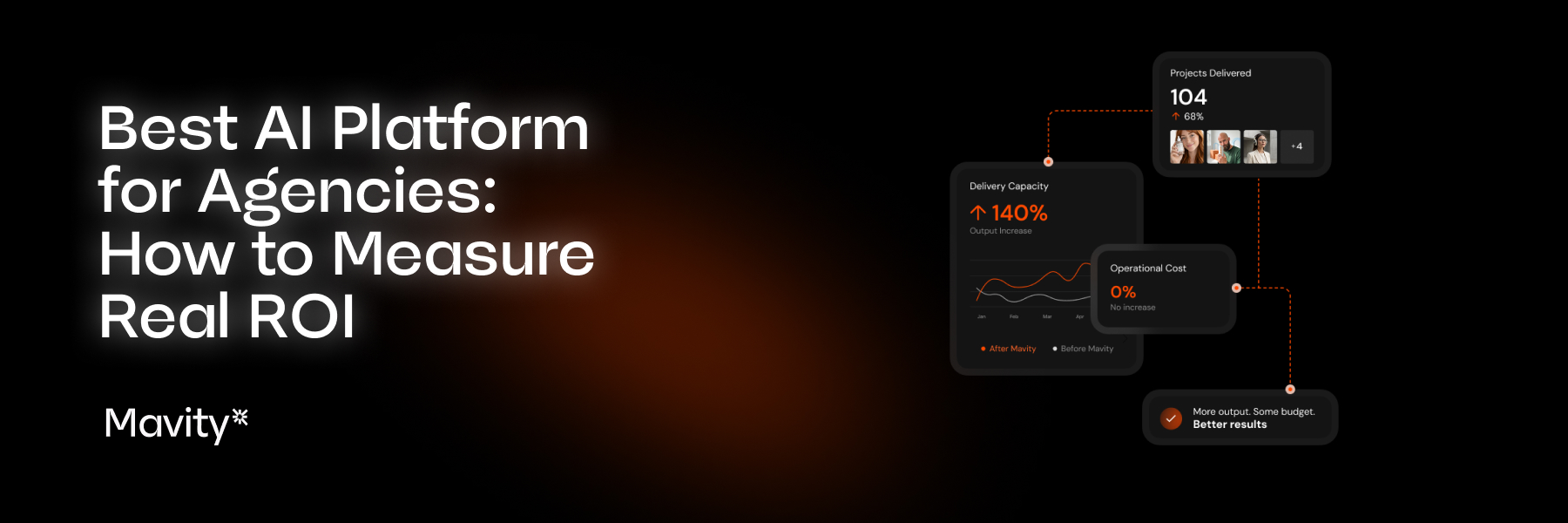
The best AI platform for your agency isn't the one with the longest feature comparison table against Canva, Adobe Firefly, or Jasper. It's the one that shortens your actual production cycle; brief to approved deliverable, and holds up when you run the numbers on cost per deliverable, not cost per seat.
Mavity was built around that framing: one workspace for brief-to-campaign production across formats, priced for agency workflows rather than individual seats. If you're currently running a stack of point tools, the ROI question worth asking isn't "what does this cost," but "what is our current stack already costing us in coordination time."
Sign up for Mavity Platform, and bring your own brief in, see what brief-to-delivery looks like collapsed into one place.