Don’t miss our latest updates
Get news and content delivered straight to your inbox
Thank you! Your submission has been received!
Oops! Something went wrong while submitting the form.


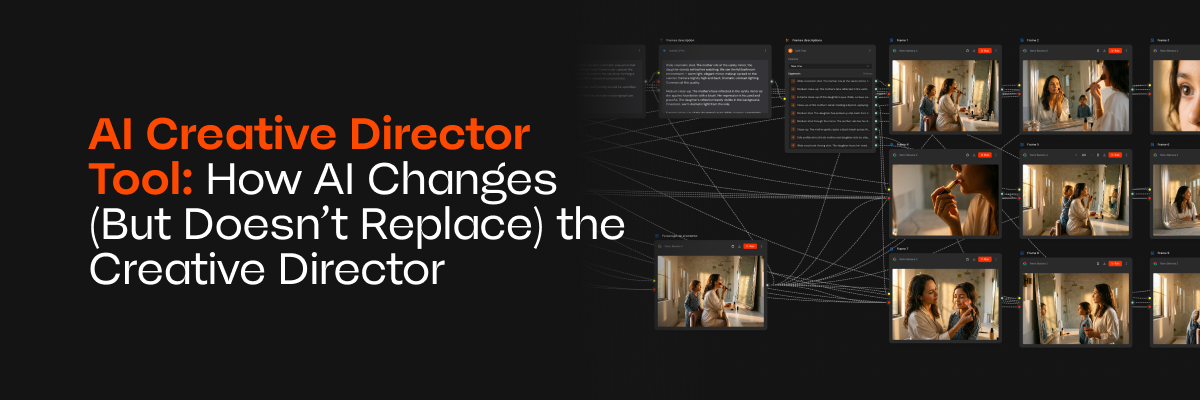
As a Creative Director, I’ve spent a lot of time reviewing work, searching for references, giving feedback, building presentations, exploring visual directions, and trying to translate an idea in my head into something the rest of the team can actually see.
AI has changed a lot of that.
Today, I can explore a visual concept before assigning it to a designer. I can test different ways to communicate an idea, build rough storyboards, organize references, or generate variations more efficiently than before.
That doesn’t mean the creative work disappears.
Exploring, prompting, refining, rejecting outputs, combining ideas, and finding the right direction still takes time and creative effort.
AI doesn’t remove the work. It changes where some of that work happens.
And naturally, that raises a question:
If AI can participate in so many parts of the creative process, what happens to the Creative Director?
I don’t think the role disappears.
I think it evolves.
Before GenAI, exploring multiple directions often required more production time and resources.
If I wanted to see three completely different visual routes, someone had to create them. That meant briefing a designer, finding references, designing, reviewing, adjusting, and probably doing another round before we could really evaluate the idea.
Because of that, we naturally had to narrow things down earlier.
AI changes that equation.
We can explore more compositions, test different photography styles before organizing a shoot, visualize a campaign idea before presenting it to a client, or turn a rough thought into something tangible enough for the team to react to.
But getting to a great idea still requires work.
In fact, having the ability to explore more creates a different challenge:
More possibilities also mean more decisions.
Someone still has to understand the business problem, the audience, the brand, the strategy, and the creative opportunity well enough to recognize which directions are worth exploring and which are simply polished distractions.
That’s where I think the Creative Director becomes even more important.
I don’t think an AI creative director tool should replace the person making creative decisions.
It should give that person a much larger playground.
Instead of investing the same amount of production time into visualizing every possibility, I can use AI to explore what could happen if we change the composition, push the concept further, introduce a completely different reference, or take an idea in an unexpected direction.
That exploration still requires intention, iteration, and judgment. But it allows us to test possibilities earlier and develop ideas before committing more resources to them.
The value isn’t necessarily the first thing AI generates.
The value is being able to think visually closer to the speed at which ideas happen.
That changes where I spend part of my time.
Less on “How do we visualize this idea?”
More on:
“Is this the right idea?”
“Can we push it further?”
“Does this solve the problem?”
“Does this actually feel like the brand?”
AI expands the space for exploration.
Creative direction determines where that exploration should go.
Another change I’ve noticed is that directing AI forces us to become much clearer about our own thinking.
A designer can ask questions. A copywriter can challenge the brief. A photographer can interpret a reference and bring their own perspective to it.
AI will start working with whatever direction we give it.
If our input is vague, we see the consequences almost immediately.
That means a larger part of creative direction now happens before the output exists.
What context are we providing? What are we trying to achieve? Which references actually matter? What should the work feel like? What should we avoid? How far can we push the brand?
Prompts are part of that, but I don’t think this is simply about becoming better at prompting.
It’s about becoming better at articulating creative intent.
Working well with AI is a creative skill in itself. It requires experimentation, iteration, reference building, critical thinking, and knowing when an output needs another round instead of simply accepting what the model gives us.
The clearer the thinking, the more useful AI becomes.
This is where I think conversations about AI replacing creative roles sometimes miss the point.
The difficult part of creative direction has never been simply producing something visually interesting.
It’s deciding what should exist in the first place.
AI can generate a beautiful image that doesn’t solve the problem.
It can write a clever headline that says nothing meaningful.
It can give us twenty campaign concepts that are perfectly acceptable and completely forgettable.
And because AI allows us to visualize ideas earlier and at a higher level of finish, mediocre ideas can sometimes appear much more resolved than they actually are.
That’s why judgment becomes critical.
Someone still needs to say:
This is beautiful, but wrong.
This is on-brand, but predictable.
This is interesting, but doesn’t solve the business problem.
This one has something. Let’s keep going.
That decision is creative direction.
I don’t mean curator as someone who simply chooses their favorite output from a grid of AI generations.
The role is much more active than that.
A Creative Director gives AI context, challenges the first answer, combines references, identifies opportunities, rejects clichés, pushes promising ideas further, and then brings human creatives into the process where their craft and perspective can make the work better.
AI becomes another creative collaborator — a highly efficient one — but it still needs direction.
This can also change how we work with our teams.
Instead of explaining an abstract idea and hoping everyone imagines the same thing, I can arrive with visual explorations that make the conversation more concrete. A designer can challenge them. A copywriter can introduce another perspective. A motion designer can see possibilities I hadn’t considered.
AI doesn’t have to remove people from the creative process. It can help us start better conversations with them.
For me, the best AI tools for Creative Directors shouldn’t try to be the Creative Director.
They should help us work more efficiently around the parts of the role that can benefit from AI.
Help me bring brand context into the process. Explore ideas across different AI models. Turn a direction into multiple executions. Save a process when it works. Share it with the team. Iterate without rebuilding everything from scratch.
This is where I see tools like Mavity fitting into the creative process.
Brands can bring brand context into creation, while Flows can turn successful creative processes into something the team can reuse, edit, and continue developing.
The technology helps make parts of the process more efficient.
The Creative Director keeps ownership of the direction.
As AI becomes more integrated into creative workflows, I think our value will be increasingly defined by the things that remain deeply human: taste, judgment, context, curiosity, strategy, storytelling, and the ability to recognize potential in an idea before it’s fully formed.
Being able to execute still matters.
Knowing what is worth executing and why matters just as much.
And maybe that’s one of the most interesting things AI can do for creative leadership: allow us to spend more of our creative energy on the part of the job that was always supposed to be ours.
Thinking.
Questioning.
Choosing.
Directing.
The future Creative Director isn’t the person who can generate the most. It’s the person who can create clarity when the number of creative possibilities has become almost infinite.