

Don’t miss our latest updates
Get news and content delivered straight to your inbox
Thank you! Your submission has been received!
Oops! Something went wrong while submitting the form.


If you ask a marketing team where their content production time goes, they'll usually say "creating content." But when you actually map the process (and I've done this exercise with our own team at Mavity) a different picture shows up.
The hours aren't in the creating. They're in the in-between: writing the request, waiting for design, chasing feedback, resizing for five platforms, hunting for the approved logo file, re-doing the version someone edited from the wrong source. Creation is minutes. Coordination is days.
That's why AI content workflow automation is a bigger deal than AI content generation. Generation speeds up the minutes. Automation removes the days.
Take something as ordinary as a weekly product post. The real workflow is something like: brief → visual concept → image production → copywriting → brand review → format adaptations → final review → publish. Eight steps, four people, at least three waiting periods.
Multiply that by every campaign, every channel, every week, and you understand why content teams feel permanently behind even when everyone is working hard.
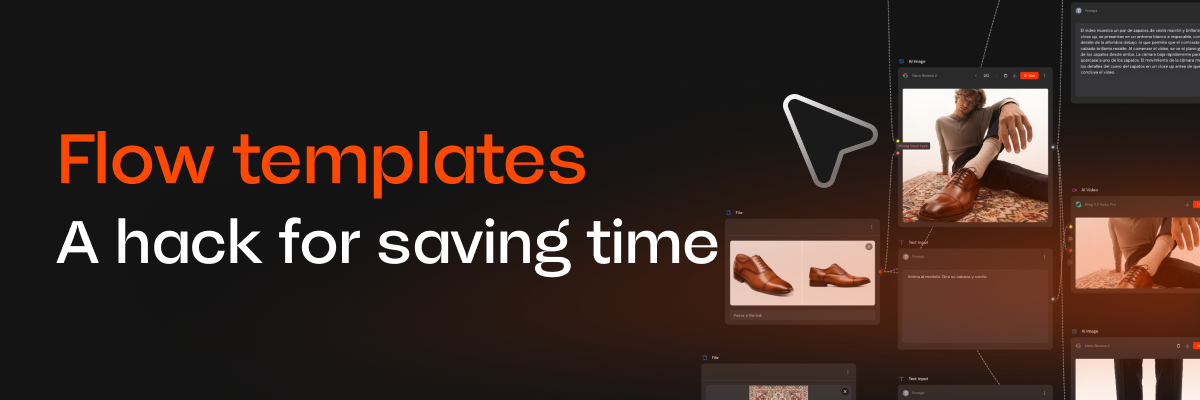
With an automated workflow (in Mavity we call them flows) that same chain becomes a single connected sequence: brand context loads automatically, image generation feeds into video, copy variations generate alongside, and format adaptations happen as a step, not as an afternoon.
What stays human: the brief and the judgment. Deciding what the campaign should say, and deciding whether the result is actually good, are still your job. In my experience, automation makes those two moments more important, because they're the only ones left.
Being honest about where the time savings come from matters, because it tells you what to automate first:
Handoffs. Every time work moves between people or tools, time leaks. A connected workflow has no handoffs inside it.
Repetition. A flow that produced this week's posts produces next week's with new inputs. You stop rebuilding the same process every Monday.
Format adaptations. Resizing and reformatting for each platform is the most automatable work in all of marketing, and it is where a shocking amount of hours hide.
Brand consistency checks. When your brand is loaded into the system, "is this on-brand?" stops being a review cycle and becomes a default.
The teams I've seen fail at this tried to automate everything at once. The teams that succeed pick one recurring, well-understood content need (ad variations for one channel, weekly social posts for one product line) and build one solid flow for it.
Run it. Edit the steps that aren't right. Run it again. When it's good, share it with the team so the next person doesn't start from zero. One reliable flow, reused weekly, compounds fast.
A simple before/after is enough: how long did this campaign type take from brief to published, before and after the flow? If you want one more metric, track how many pieces you ship per week with the same team. Those two numbers are what make the case internally better than any tool demo.
I want to end with a caution, because automation has an obvious failure mode: filling every channel with more content nobody asked for. The hours you save are the actual prize. Spend them on the parts machines are bad at: strategy, ideas, taste.
Automate the production. Keep the thinking.